By Cool Cats Air Conditioning Services Ltd — MCS-certified, F-Gas registered commercial HVAC contractors based in Lowestoft, Suffolk, serving East Anglia, London and the UK nationwide.
Choosing a commercial HVAC contractor is one of the more consequential decisions a UK business or facilities manager makes. The right contractor keeps your building compliant, your running costs down and your premises comfortable for years. The wrong one leaves you with an oversized system, void warranties, failed inspections and recurring breakdowns.
This guide explains exactly what to look for when choosing a commercial heating, ventilation and air conditioning (HVAC) contractor in 2026 — including the accreditations that matter, the regulations your contractor must keep you compliant with, and the questions to ask before you sign.
Quick answer
A good commercial HVAC contractor in the UK should be REFCOM F-Gas registered, employ F-Gas certified engineers, hold relevant manufacturer accreditations (such as Mitsubishi Electric, Daikin or Toshiba), carry recognised safety and competency accreditations (SafeContractor / SSIP), and provide design, installation, commissioning and ongoing maintenance in-house. They should size systems with a proper heat-load survey, specify low-GWP refrigerants to keep you compliant with tightening F-Gas rules, and document everything for your records, insurers and statutory inspections.
Why your choice of contractor matters more in 2026
Two regulatory pressures make 2026 a pivotal year for commercial HVAC, and both put the onus on using a properly qualified contractor.
The F-Gas refrigerant phase-down. UK F-Gas regulations are steadily restricting high-GWP (Global Warming Potential) refrigerants. Servicing older systems that rely on high-GWP refrigerants such as R-404A is increasingly restricted, and the supply of high-GWP HFCs continues to be squeezed. In practice this means systems installed 8–15 years ago can become expensive or difficult to maintain, and businesses are moving to future-proof, low-GWP refrigerants such as R-32. A competent contractor will advise you on whether to upgrade or maintain, and will only specify systems that keep you compliant for the long term.
Tightening building energy standards. Under the Minimum Energy Efficiency Standards (MEES), commercial properties in England and Wales must meet a minimum EPC rating, and the required standard is set to rise over the coming years. Because heating and cooling are among the largest energy loads in most commercial buildings, an efficient, well-designed HVAC system is one of the most effective ways to improve a building’s energy performance. The contractor you choose directly affects whether your building keeps pace with these standards.
The accreditations that actually matter
Accreditations are not decoration — several are legal requirements, and the rest are genuine signals of competence. Look for:
REFCOM F-Gas registration (essential). Any company that installs, services or maintains stationary air conditioning, refrigeration or heat pump equipment containing fluorinated gases must hold an F-Gas company certificate by law. REFCOM is the UK register of companies certified to handle refrigerants. Using an uncertified installer is illegal and can void equipment warranties. This is the single most important box to tick.
F-Gas certified engineers. Company certification and individual engineer certification are separate requirements. The engineers physically handling refrigerant on your site must hold the appropriate F-Gas qualification.
Manufacturer accreditation. Accreditation from a manufacturer (for example, a Mitsubishi Electric Accredited Installer) means engineers are trained on that equipment and installations qualify for the manufacturer’s full warranty. It also signals the contractor works to a consistent, audited standard.
Safety and competency schemes (SafeContractor / SSIP). SafeContractor and other SSIP-recognised schemes assess a contractor’s health, safety and competency processes — important for any work on commercial premises and often required by larger clients and facilities managers.
MCS certification (relevant where heat pumps are involved). MCS certification is the standard for low-carbon heating technology such as air source heat pumps, and is required for projects accessing government grant schemes.
The compliance obligations a good contractor keeps you ahead of
A capable commercial HVAC contractor doesn’t just install equipment — they keep your business on the right side of the law. Two obligations are worth knowing:
TM44 air conditioning inspections. If your commercial air conditioning has a combined cooling capacity greater than 12kW, it must be inspected by an accredited energy assessor every five years under the Energy Performance of Buildings Regulations. The inspection reviews efficiency and recommends improvements. A good contractor will flag this and help you stay compliant.
F-Gas record-keeping and leak checks. Systems containing fluorinated gases are subject to mandatory leak checks and record-keeping. Penalties for non-compliance can be significant. Your contractor should carry these out and maintain the documentation on your behalf.
Design and sizing: the part most buyers overlook
The difference between an HVAC system that quietly performs for years and one that’s noisy, costly and inadequate is almost always design.
A professional contractor begins every commercial project with a site survey and a heat loss/gain calculation to size the system to the real demands of your premises — taking account of occupancy, glazing, layout and how the space is used. Oversized systems waste energy and money; undersized systems can’t keep up. Be wary of any contractor who quotes a system without surveying the building first.
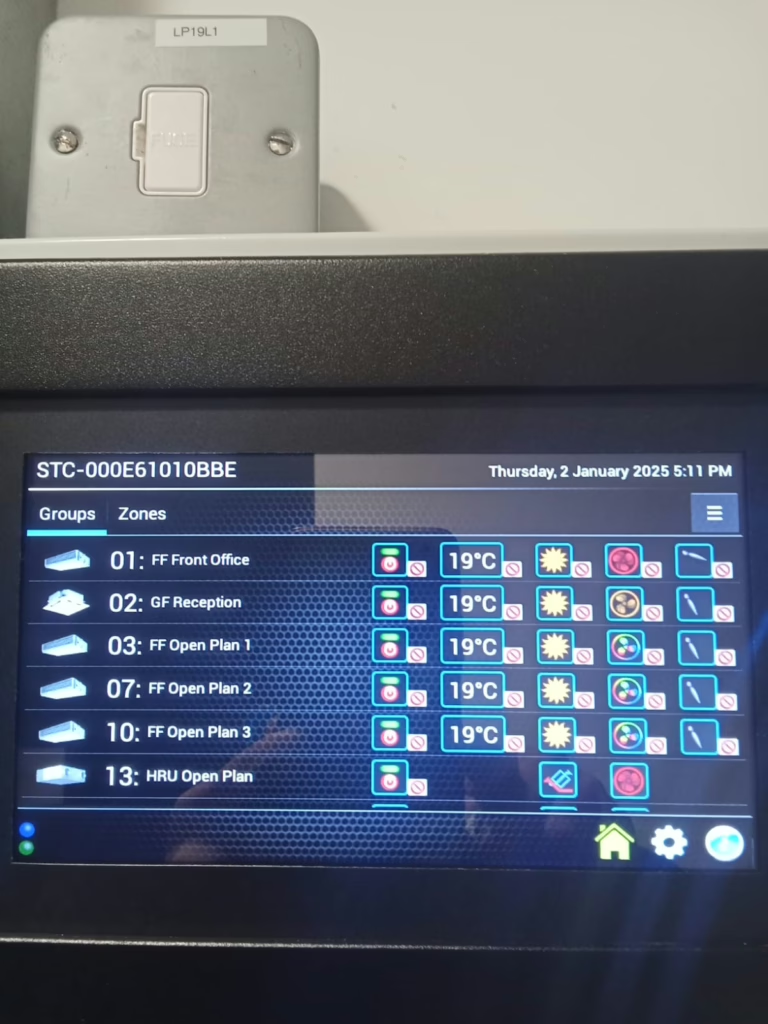
For larger or multi-zone premises, ask whether they design and install VRF/VRV systems (which allow independent control across zones and are highly efficient) and ventilation including MVHR (mechanical ventilation with heat recovery), as well as straightforward split and multi-split air conditioning.
Full lifecycle: design, install, maintain
The strongest commercial contractors handle the complete lifecycle in-house rather than subcontracting parts of it:
- Design and survey — heat-load calculation and system specification.
- Supply and installation — to manufacturer and UK standards.
- Commissioning — testing and handover with full documentation.
- Planned preventative maintenance (PPM) — scheduled servicing that catches faults before they become failures, keeps systems efficient and extends equipment life.
- Reactive repair and emergency response — minimising downtime when something fails.
A contractor who designs, installs and maintains is accountable from survey to aftercare — there’s no finger-pointing between separate firms when something goes wrong.
10 questions to ask before you sign
- Are you REFCOM F-Gas registered, and can you provide your certificate number?
- Are the engineers attending my site individually F-Gas certified?
- Which manufacturers are you accredited by, and will my installation carry the full manufacturer warranty?
- Are you SafeContractor / SSIP approved?
- Will you carry out a site survey and heat-load calculation before quoting?
- Will you specify low-GWP refrigerants to keep me compliant with the F-Gas phase-down?
- Does my system need a TM44 inspection, and will you help me stay compliant?
- Do you offer planned preventative maintenance contracts?
- What’s your emergency response time for commercial breakdowns?
- Can you share examples or case studies of similar commercial projects?
Sectors a commercial HVAC contractor should serve
A genuine commercial contractor works across offices, retail units, industrial and warehouse premises, hospitality and leisure, healthcare and the public sector — scaling from a single office split system to multi-building VRF and ventilation projects.
How Cool Cats fits the brief
Cool Cats Air Conditioning Services Ltd is an F-Gas registered, MCS-certified (APH-48076) commercial HVAC contractor based in Lowestoft, Suffolk, serving businesses across East Anglia, London and the UK. We are a Mitsubishi Electric Accredited Installer and work across all major manufacturer brands, and we are REFCOM F-Gas registered, SafeContractor (SSIP) approved, TrustMark registered and RECC approved.
We design, install, commission and maintain commercial HVAC in-house — split and multi-split air conditioning, VRF/VRV systems, air source heat pumps, ventilation and MVHR, and planned preventative maintenance. Every project starts with a site survey and heat-load calculation, and every installation is documented for compliance, insurance and facilities management.
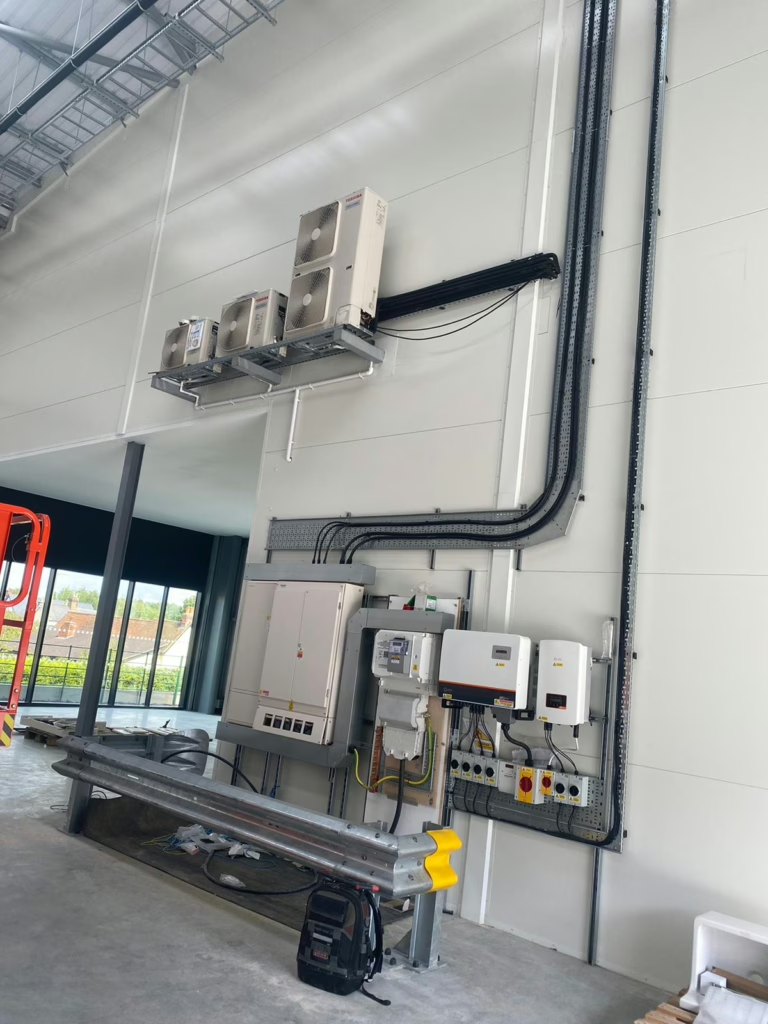
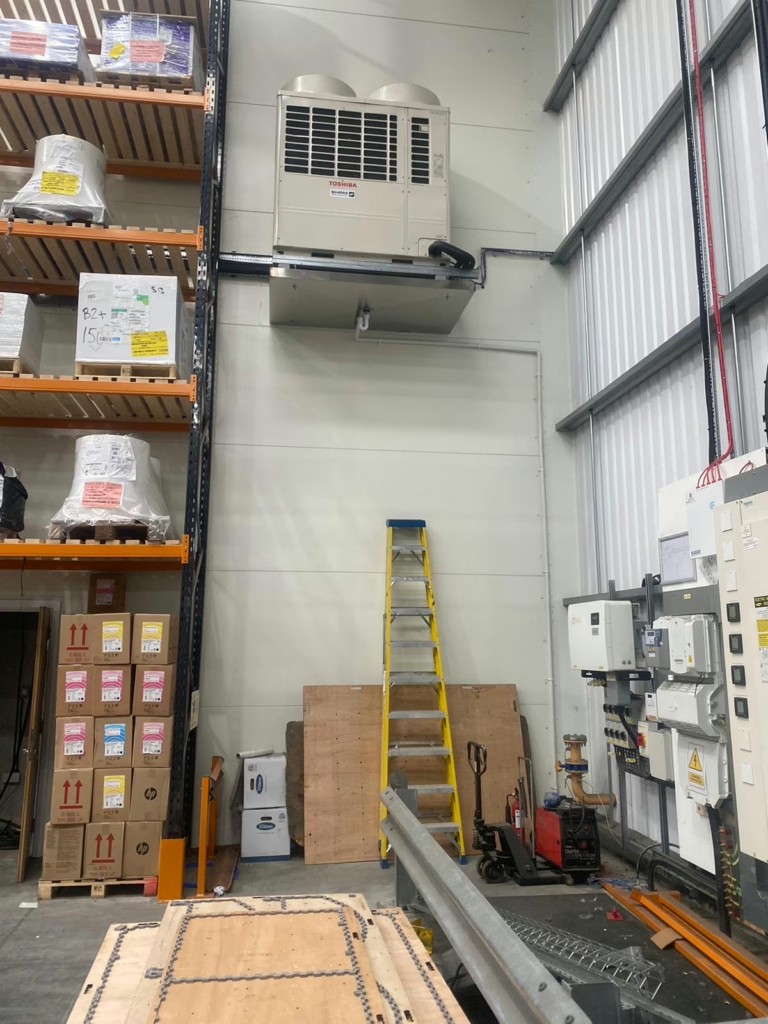
You can see examples of our commercial work, including a seven-building Toshiba VRF and MVHR installation in Bishops Stortford, in our case studies.
Get a commercial HVAC quote
Call 01502 448114 or email hello@ccacservices.uk to arrange a site survey and a no-obligation proposal. We respond to commercial clients across East Anglia, London and the UK nationwide, including emergency call-outs.